

For years, Israel and Iran fought a tense, often hidden conflict. It played out through proxies, sabotage claims, cyberattacks, and strikes far from each country’s borders. That changed in mid-June 2025, when the confrontation turned direct and fast. In less than two weeks, both sides launched major operations, the region got pulled in, and the United States faced pressure to contain the fallout.
This article looks back at the key moments of what US President Donald Trump reportedly called the “12-day war,” and explains the military, political, and regional stakes that emerged when two arch-enemies stopped avoiding a head-to-head fight.
Source note: This overview is an original write-up based on public reporting, including details reported by France 24. You can read the original France 24 report here: France24.com.
From shadow conflict to open strikes
The risk of a direct Israel-Iran war had been building for decades. Israeli leaders, including Prime Minister Benjamin Netanyahu, repeatedly framed Iran’s nuclear program as an existential threat. Iranian leaders, for their part, continued hostile rhetoric toward Israel and supported armed groups opposed to Israel, including in Gaza and Lebanon.
By 2024 and into 2025, the pattern of limited exchanges was already shifting. Missiles and drones were launched, and air defenses were tested. Still, many observers believed both states preferred to keep fighting indirect, because direct war carries bigger risks: escalation, civilian harm, and unpredictable reactions from neighbors.
That assumption broke on June 13, 2025. Reports of explosions in Tehran appeared in the early hours. Netanyahu announced the start of an Israeli operation called “Rising Lion.” What followed was a short, intense campaign that targeted Iranian military and nuclear-linked sites, and triggered a retaliatory response from Iran.
Israel’s opening move: air power, surprise, and nuclear-linked targets
Israel’s first wave was designed to overwhelm and confuse. According to reporting referenced by France 24, Israel used a large number of aircraft in its initial strikes and hit multiple sites across Iran, including major nuclear facilities such as Natanz, Fordo, and Isfahan.
The key feature of the campaign was tempo. By moving quickly, Israel aimed to reduce Iran’s ability to coordinate defenses, protect critical infrastructure, and control escalation. Over the following days, Israeli strikes continued across Iranian territory. A monitoring group cited in the France 24 report (ACLED) described hundreds of strikes across many provinces, with a heavy concentration around Tehran.
Another notable element was the use of remotely piloted drones, including first-person-view systems, reportedly deployed by undercover operatives to hit sensitive targets early. This kind of tactic, if successful, can shrink response time and create the feeling that critical sites are vulnerable from within.
High-level losses and the message to Tehran
Beyond infrastructure, the strikes reportedly targeted senior leadership and technical expertise. France 24 reported that at least twenty senior officers were killed early, including top commanders. The report also described targeted killings of nuclear scientists during the conflict, which is significant for two reasons.
First, it signals intent. If a campaign aims to set back nuclear progress, people can be as important as facilities. Second, it carries political weight inside Iran. High-profile losses can increase pressure on leaders to respond strongly, even if they want to avoid wider war.
From Israel’s perspective, striking leadership and key specialists may have been intended to reduce Iran’s operational capacity and deter future escalation. From Iran’s perspective, such strikes could be seen as crossing a red line, making retaliation more likely and more public.
Iran’s response and the risk of regional spillover
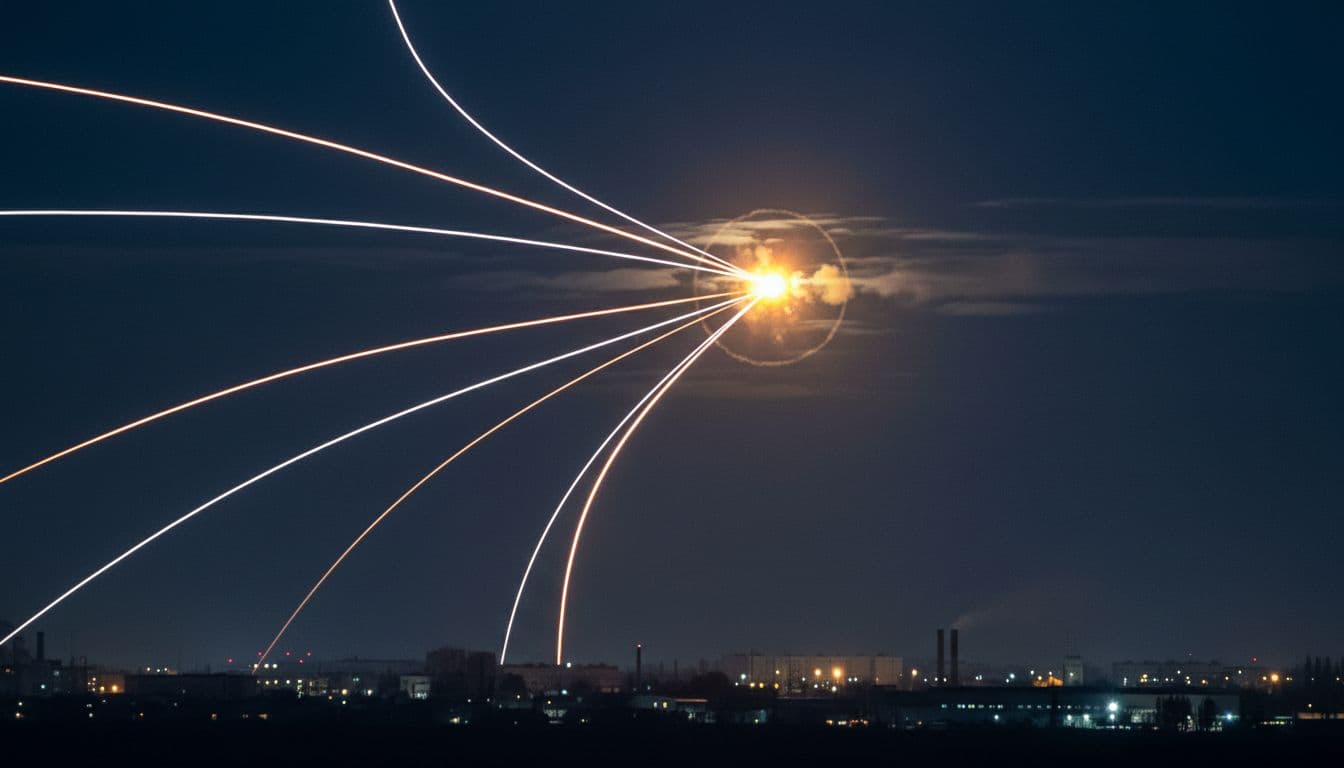
Iran retaliated with missiles and drones, and Israel’s air defenses went to work. Even when interceptions happen, the psychological impact can be huge. Alerts, shelters, and uncertainty become part of daily life. Markets react. Airlines reroute. Diplomacy tightens.
The conflict also pulled in neighboring countries. France 24 noted that states such as Jordan and Qatar were drawn into the crisis environment, while the United States faced a central role as a power with regional bases, alliances, and leverage.
This is one reason the conflict mattered far beyond Israel and Iran. A direct exchange increases the odds of miscalculation: a missile landing in the wrong place, an air defense error, or an attack interpreted as broader than intended. Once that happens, leaders have less room to step back.
Why it stayed short: constraints, costs, and outside pressure
Twelve days is long enough to cause serious damage and fear, but short compared with many conflicts in the region. Several factors likely helped keep the war contained.
- Military limits: Even strong militaries face constraints. Long-range strike campaigns require logistics, intelligence, and sustained political will.
- Economic pressure: Markets do not like uncertainty. Energy prices, shipping insurance, and investment risk can rise fast.
- Regional politics: Neighboring states often push for de-escalation when they fear being pulled in.
- US involvement: Washington’s posture can influence decisions on both sides, especially when wider escalation threatens US forces or global trade routes.
It is also possible that both governments believed they had achieved key aims quickly. Israel may have sought a sharp blow to Iran’s capabilities. Iran may have sought a response strong enough to claim deterrence without inviting an even larger wave of strikes.

What the 12-day war changed
The biggest shift was psychological and strategic: direct conflict is no longer theoretical. That changes how both sides plan, and how neighbors prepare. Air defense networks, early warning systems, and civil protection measures become more central. The same goes for diplomacy, because the next crisis could come faster than expected.
It also raises new questions about Iran’s nuclear program. Strikes can damage sites and disrupt operations, but they can also harden positions. If leaders conclude that negotiations do not protect them, they may double down. If they conclude the costs are too high, they may become more open to constraints. Either path is plausible, and both will be shaped by internal politics.
For Israel, the conflict may strengthen deterrence in the short term while increasing long-term risk. If Iran rebuilds capabilities and prepares for the next round, Israel could face repeated cycles of escalation. The region has seen that pattern before.
Where things go from here
Even after a ceasefire or pause, the drivers of conflict remain: nuclear fears, regional alliances, and mutual distrust. A short war can create a false sense of closure, but it often sets new baselines. Each side learns what worked, what failed, and where the other side is vulnerable.
In the months ahead, watch for four signals. First, whether diplomatic channels reopen or freeze. Second, whether either side continues covert operations. Third, whether proxies become more active again. Fourth, whether regional states build stronger coordination to prevent accidental spillover.
The 12-day war showed how quickly a long-running rivalry can become direct and explosive. It also showed that, even in the middle of intense strikes, outside pressure and practical limits can still pull leaders back from a wider regional war. The next test will be whether that restraint holds when the next crisis arrives.
To contact us click Here .